

Baked Austrian crêpes with creamy curd cheese filling are a warm, old-fashioned sweet dish made with very thin crêpes, a mild dairy filling, and gentle oven baking.
These crêpes are not thick pancakes. They are soft, thin, and flexible, much closer to French crêpes than to American pancakes.
The original family recipe was short and handwritten, as many old home recipes were. It listed the important parts clearly enough: flour, eggs, milk, salt, curd cheese, sugar, beaten egg whites, and baking in a hot oven.
What it did not explain were the small kitchen details that an Austrian grandmother would simply have known by heart.
This version keeps the character of the old family recipe, but explains the ingredients, measurements, and oven temperature in a way that is easier to follow in a modern kitchen.
About this recipe
This is not a recipe for crêpes that are eaten straight from the pan.
First, thin crêpes are cooked in a frying pan. Then they are filled with a lightly sweet curd cheese mixture, placed in a baking dish, and baked until warm, soft, and gently set.
The result is mild, creamy, and comforting without being overly sweet.
In Austrian home cooking, sweet dishes like this can be served as dessert, but they are also often eaten as a sweet main course after a light soup.
The old handwritten recipe mentions a very hot oven temperature of 250°C. For modern ovens, that is usually too high. A lower temperature allows the filling to set gently without drying out the crêpes.
About the original Austrian name
The original Austrian name of this dish is:
Topfenpalatschinken aus dem Rohr
or:
Überbackene Topfenpalatschinken aus dem Rohr
This name is important as part of the family recipe, but it is not very helpful as an English title.
Topfen means an Austrian-style curd cheese.
Palatschinken are thin Austrian crêpes.
Rohr is an older Austrian word for oven.
So, instead of using the original name as the title, this English version describes the dish more naturally as:
Baked Austrian Crêpes with Creamy Curd Cheese Filling
The original name is still included here for cultural context, but the rest of the recipe uses English wording so the dish is easier to understand.
Original image
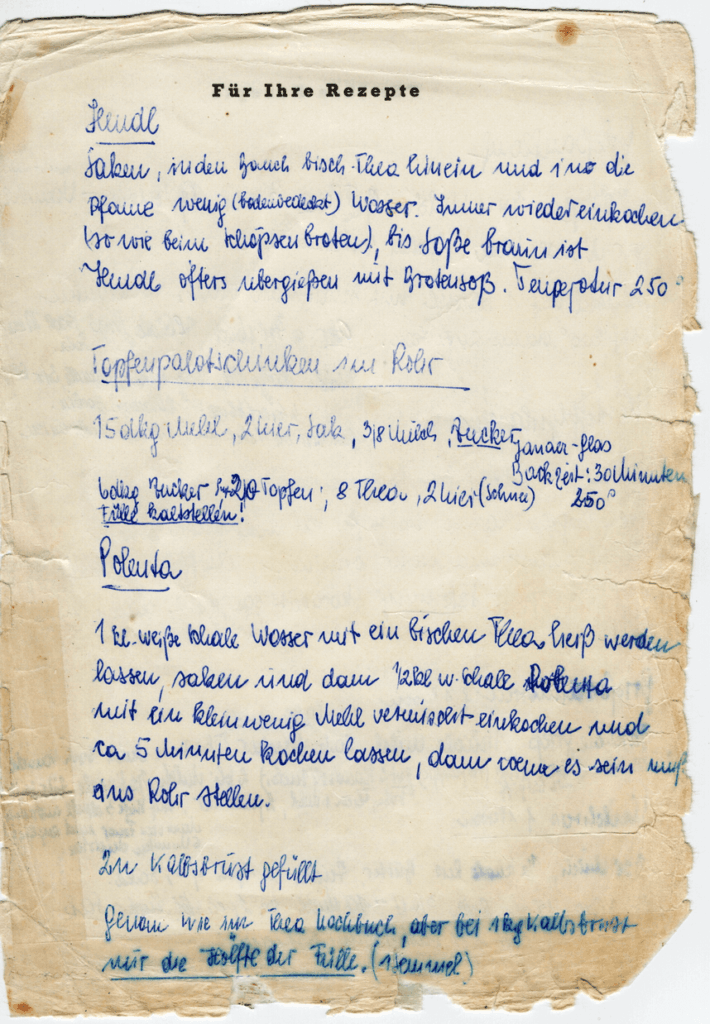
Photo by the author, 2026
Open the image and save it with a right click.
Note about the old handwritten recipe
This recipe is based on an old handwritten family recipe.
Some parts are easy to read, while others are only partly clear. The recognizable ingredients include flour, eggs, salt, milk, Austrian curd cheese, sugar, beaten egg whites, and instructions to bake the filled crêpes in the oven.
The old recipe also mentions a very hot oven and a baking time of about 30 to 45 minutes.
For today’s ovens, the temperature has been adjusted. Modern ovens are often more even and more powerful than older household ovens. A slightly lower temperature gives the filling time to set without drying out the crêpes.
The goal is not to turn this into a modern restaurant-style dessert. It should remain a simple, warm Austrian family dish.
Ingredients
For about 6 to 8 filled crêpes
For the crêpe batter
- 150 g plain flour or all-purpose flour
- 2 eggs
- 1 pinch of salt
- 375 ml milk
a little butter or neutral oil for cooking the crêpes
For the creamy curd cheese filling
- 250 g Topfen, quark, or another suitable curd cheese substitute
- 2 eggs, separated
- 2 to 3 tablespoons sugar, to taste
- 1 pinch of salt
optional: a little vanilla sugar or finely grated lemon zest
For the baking dish
a little butter or margarine
optional: a little sugar for sprinkling
Optional topping before baking
a little sour cream, milk, or cream
This is not clearly written in the old recipe, but it is useful in a modern kitchen. A small amount keeps the crêpes soft and prevents them from drying out in the oven.
Ingredient notes for English-speaking readers
Flour
Use plain flour in the UK or all-purpose flour in the US.
The original recipe uses 15 dkg of flour. This is an older Central European way of writing weight. 15 dkg equals 150 g.
The batter should be thin enough to spread easily across the pan. It should not look like thick pancake batter.
If the batter becomes too thick after resting, add a small splash of milk.
Milk
The original recipe uses 3/8 litre of milk.
That equals 375 ml.
This amount works well with 150 g flour and 2 eggs. Depending on the flour, the batter may need a little more or less liquid.
The batter should flow easily when the pan is tilted.
Curd cheese filling
The original recipe uses Topfen, an Austrian fresh dairy product. It is mild, slightly tangy, creamy, and usually firmer than yogurt.
In English-speaking countries, it may be easier to understand it as an Austrian-style curd cheese.
If you cannot find it, quark is usually the closest substitute. Other options can also work, but the texture should not be too wet.
If you cannot find Austrian curd cheese
You can use one of these substitutes:
- quark
- well-drained farmer’s cheese
- well-drained Greek yogurt
- blended cottage cheese
- cream cheese mixed with a little yogurt
The flavor and texture will change slightly depending on the substitute.
Greek yogurt gives a softer and tangier filling. Cottage cheese should be blended smooth first. Cream cheese gives a richer result, so it is best mixed with yogurt to make it lighter.
For this recipe, the filling should be creamy but not runny.
Eggs and beaten egg whites
The old recipe refers to beaten egg whites.
The eggs are separated. The yolks are mixed into the curd cheese filling, and the egg whites are beaten until fluffy before being folded in.
This makes the filling lighter and softer.
Sugar
The old recipe mentions sugar, but not a precise amount.
This version uses 2 to 3 tablespoons, which gives a mild sweetness. If you prefer a sweeter dessert, add a little more sugar or dust the finished crêpes with powdered sugar.
Modern measurement notes
Older Austrian recipes often use measurements such as dkg, fractions of a litre, or simple spoonfuls.
For modern kitchens, the key conversions in this recipe are:
- 15 dkg flour = 150 g flour
- 3/8 litre milk = 375 ml milk
- 250°C in the old recipe = better adjusted to about 180 to 190°C for modern ovens
For US readers, using a kitchen scale is the easiest and most accurate method for this recipe.
Approximate conversions:
- 150 g flour is about 1 1/4 cups all-purpose flour
- 375 ml milk is about 1 1/2 cups plus 1 tablespoon milk
- 250 g curd cheese is about 1 cup
Because flour and dairy products can vary, metric measurements are more reliable here than cup measurements.
How to Make Baked Austrian Crêpes with Creamy Curd Cheese Filling
1. Make the crêpe batter
Place the flour, eggs, salt, and milk in a mixing bowl.
Whisk everything together until the batter is smooth and thin.
There should be no large lumps.
Let the batter rest for about 15 to 20 minutes.
This allows the flour to absorb the liquid and makes the crêpes easier to cook.
2. Cook the crêpes
Heat a frying pan over medium heat and brush it lightly with butter or oil.
Pour a small amount of batter into the pan.
Tilt the pan so the batter spreads thinly across the surface.
Cook until the crêpe loosens from the pan, then turn it over and cook the other side briefly.
Continue until all the batter is used.
The crêpes do not need to become deeply browned because they will be baked again in the oven.
3. Prepare the curd cheese filling
Separate the eggs.
Place the curd cheese, egg yolks, sugar, and a pinch of salt in a bowl.
Mix until smooth.
Add a little vanilla sugar or finely grated lemon zest if desired.
Beat the egg whites until soft and fluffy.
Carefully fold the beaten egg whites into the curd cheese mixture.
The filling should be soft and light, but not runny.
4. Fill the crêpes
Spread a little filling over each crêpe.
Roll them up, or fold them loosely if you prefer.
Grease an ovenproof baking dish with butter or margarine.
Place the filled crêpes next to each other in the dish.
They can sit close together, but they should not be pressed down too tightly.
5. Prepare the dish for baking
Preheat the oven to 180 to 190°C using top and bottom heat.
If using a fan oven, 170°C is usually enough.
The old handwritten recipe mentions a higher oven temperature, but a gentler heat is safer for modern ovens.
If desired, pour a little sour cream, milk, or cream over the filled crêpes.
This helps keep them moist while they bake.
6. Bake in the oven
Place the baking dish in the preheated oven.
Bake for about 25 to 35 minutes, until the filling has set and the surface has a little color.
If the crêpes brown too quickly, lower the temperature slightly or cover the dish loosely.
The old recipe gives a baking time of about 30 to 45 minutes, so the exact time can vary depending on the dish, the filling, and the oven.
7. Let them rest before serving
Remove the baked crêpes from the oven.
Let them rest for a few minutes before serving.
This helps the filling settle and makes the crêpes easier to lift from the dish.
Dust with powdered sugar if desired and serve warm.
Tips for best results
Let the batter rest
A short resting time makes the batter smoother.
If the batter is used immediately, the crêpes may tear more easily. After 15 to 20 minutes, the batter usually spreads better in the pan.
Keep the crêpes thin
The crêpes should be thin rather than thick.
Thick crêpes can become heavy after baking and do not absorb the filling as nicely.
Do not make the filling too wet
Curd cheese, quark, farmer’s cheese, yogurt, and cottage cheese can all contain different amounts of liquid.
If the filling already looks soft, do not add extra liquid. A filling that is too wet may leak during baking.
Fold in the egg whites gently
The beaten egg whites make the filling lighter.
Fold them in slowly instead of stirring strongly. This keeps the filling softer and airier.
Do not bake too hot
The old handwritten recipe mentions 250°C.
That is very hot for modern ovens. At that temperature, the outside may brown too quickly while the filling is still soft inside.
A moderate oven temperature of 180 to 190°C is usually safer and more reliable.
Taste and texture
Baked Austrian crêpes with creamy curd cheese filling are soft, mild, and lightly sweet.
During baking, the thin crêpes absorb some moisture from the filling and become tender. The filling stays creamy, but it should not be runny.
This is not a rich, heavy cake-like dessert. It is closer to a warm Austrian home-style sweet dish.
Lemon zest gives the filling a fresher flavor. Without lemon zest, the taste stays closer to the simple old family recipe.
How to store leftovers
These baked crêpes are best served warm from the oven.
Leftovers can be covered and stored in the refrigerator. They should be eaten within 1 to 2 days.
To reheat, use a low oven temperature until warmed through.
The microwave is faster, but the crêpes will become softer.
Serving ideas
Baked Austrian crêpes with creamy curd cheese filling go well with:
- powdered sugar
- plum compote
- applesauce
- apricot compote
- berry compote
- vanilla sauce
- a small spoonful of sour cream
As a sweet main course, they are lovely after a clear soup.
As a dessert, serve smaller portions because the crêpes and filling are quite satisfying.
Questions and answers
Final thoughts
Baked Austrian crêpes with creamy curd cheese filling are a gentle, old-fashioned family dish.
The original handwritten recipe was short, but it kept the essential idea: thin crêpes, a mild dairy filling, beaten egg whites, and baking in the oven.
For a modern kitchen, a little more explanation is helpful. The old measurements have been converted, the oven temperature has been adjusted, and the dairy ingredient has been explained for readers who may not know Austrian cooking.
The result is still simple, warm, and familiar.
Its charm comes from the soft crêpes, the creamy filling, and the feeling of bringing an old family recipe back to the table.